



Victories Update: Spring 2026
Published Mar 3, 2026
Thank you for fighting for safe food, clean water, and a livable climate!
Every day, it seems the Trump administration poses a new threat to all we hold dear — clean water, safe food, and a livable climate for all.
But thanks to dedicated people like you, building up people power and strengthening our movement, we’re continuing to defend our livable future with the force and urgency we need.
Here are recent victories you made possible.
Milestones to Celebrate
1. Called for a stop to new data centers and stopped Project Hazelnut in Pennsylvania
Last year, Food & Water Watch became the first national organization to call for a nationwide halt to the unregulated rollout of AI data center infrastructure.
With you, we’re organizing in communities across the country to stop the building of new energy- and water-intensive data centers while also working in Washington, D.C., to educate Congress members about the threats posed by their unchecked growth.
This past November, we stopped Project Hazelnut in Hazle Township, Pennsylvania. The over 1,280-acre site would have housed 15 resource-hungry data center buildings. And in December, Food & Water Watch organized a letter to Congress calling for a full moratorium on new data centers. More than 230 organizations signed on.
2. Passed Prop 50, the Election Rigging Response Act, in California
California’s Election Rigging Response Act (Prop 50) was drafted to counter President Trump’s election-rigging efforts in Texas. Trump pushed Texas Republicans to redraw Congressional district lines in order to gain five more seats in the U.S. House of Representatives.
Prop 50’s proposed new Congressional district lines could give Democrats up to five seats in the House, negating the seats Republicans could gain in Texas. Food & Water Watch endorsed Prop 50 in September, and California voters overwhelmingly passed it in November.
3. Drove seven governors to submit a petition to the EPA to monitor microplastics
In November, former New Jersey Governor Phil Murphy led a group of seven governors in urging the Environmental Protection Agency (EPA) to monitor microplastics in our drinking water.
Under the Safe Drinking Water Act, if seven governors submit a petition to list a contaminant for monitoring in drinking water, the EPA must either list it or include another contaminant of concern in its place. Together, we encouraged the Governors of New Jersey, Michigan, Illinois, Maryland, Delaware, Wisconsin, and Connecticut to take action.
This victory came after nearly a year of advocacy by Food & Water Watch volunteers and members like you, who met with governors’ staff, made thousands of phone calls, and submitted over 8,000 messages in support of microplastics monitoring.
4. Passed an ordinance protecting a Pennsylvania community from fracking industry harms
In a state where the fracking industry runs rampant, the Crafton Borough Council in Allegheny County, Pennsylvania, passed a new zoning code that includes protections for residents’ health and property values from fossil fuel development.
Food & Water Watch provided assistance and guidance for increased protection from oil and gas operations and related infrastructure during the zoning overhaul. Since our Pennsylvania team began its Municipal Ordinance Project, more than 30 Pennsylvania communities have passed ordinances to protect themselves against fracking.
5. Urged the Maryland legislature to advance a study of climate change damages
In December, we successfully urged the Maryland legislature to override Governor Wes Moore’s veto of the Responding to Emergency Needs from Extreme Weather (RENEW) Act. This law allows the state to calculate the financial harm of climate change in Maryland. The study is meant as a first step toward assessing fees on the world’s largest oil companies to help pay for such damages using Superfund-like pollution laws.
State leaders took a historic first step toward ensuring Marylanders will not have to bear the costs of a changing climate, instead making polluters pay for the damages they’ve caused.
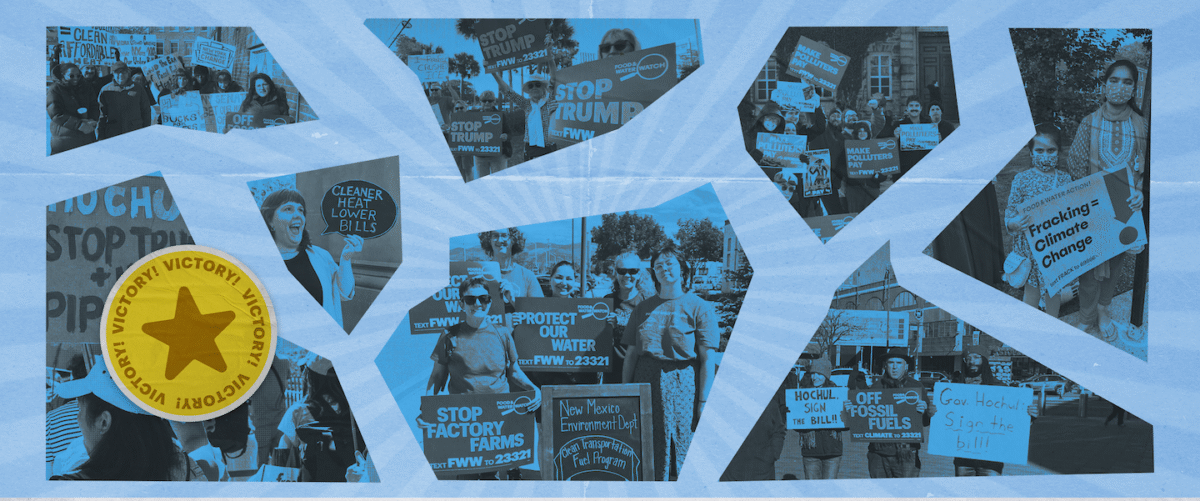
6. Pressed New York Governor Kathy Hochul to sign legislation ending the 100 foot rule
After years of advocacy against policies that prop up the fossil fuel industry at the public’s expense, the New York legislature repealed the 100 foot rule in June last year. This long-standing rule forced ratepayers to subsidize costly gas hookups for new customers.
Since then, we pressured Governor Hochul to sign this legislation into law, and in December, we won! Ending the 100 foot rule is a decisive accomplishment in the fight to reduce New York’s reliance on fracked gas. It will also save New Yorkers an estimated $600 million per year in increased energy costs.
7. Moved the USDA to pause funds for biogas digesters on factory farms
In February, the U.S. Department of Agriculture (USDA) announced that it would pause funding for systems that produce biogas from livestock manure. This announcement comes one week after Food & Water Watch and allied organizations filed a petition asking the USDA to deny loans and grants from the Rural Energy for America Program to factory farms seeking to set up anaerobic digesters.
Factory farm biogas digesters produce energy at a steep environmental cost as they increase water and air pollution. They also incentivize larger factory farms, which increases the pollution that rural communities face.
8. Won guardrails in New Mexico’s Clean Transportation Fuel Program
In January, we successfully urged New Mexico’s Environmental Improvement Board to include a provision in the state’s Clean Transportation Fuel Program to ensure that the program does not incentivize the expansion of factory farms in the state.
The Clean Transportation Fuel Program will create a statewide “carbon intensity” standard for transportation fuels and a marketplace to buy, trade, and sell carbon credits to meet that standard. During the rulemaking process, Food & Water Watch pushed regulators to include guardrails to help them determine whether a biogas project is actually avoiding methane emissions.
Each of these victories was made possible by people like you who have shown up time and again when our communities and our environment needed you the most. Thank you!
Your generosity powers victories like these! Make a gift today.
Enjoyed this article?
Sign up for updates.
TO TOP