



Stopping the Last Plunder of the Planet with Maude Barlow

Published Apr 27, 2026
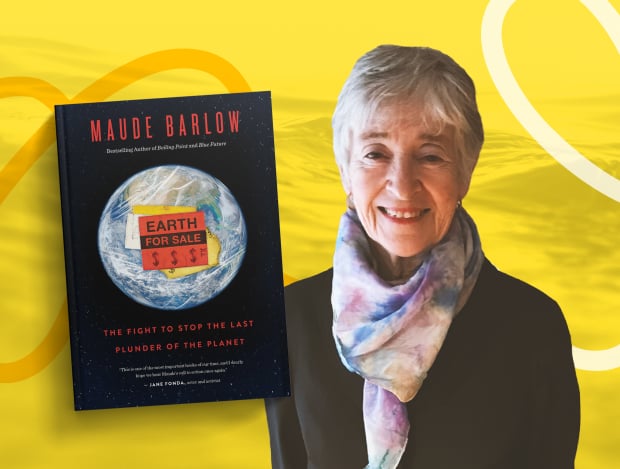
Lifelong water activist Maude Barlow talks about her new book, Earth for Sale, and what we really need to protect the planet.
From carbon offsets to water markets, corporations and financial institutions are devising more ways than ever to profit from our environment — and they’re calling them “green solutions” while they’re at it. In Earth for Sale: The Fight to Stop the Last Plunder of the Planet, Food & Water Watch Board Chair and lifelong water activist Maude Barlow illustrates how “market-based solutions” are not only failing to help the planet but, in many cases, actively harming it.
Maude has spent her career fighting to defend humanity’s access to clean water on the world stage and in her home country of Canada. She served as Senior Advisor on Water to the 63rd President of the United Nations (UN) General Assembly and was a leader in the campaign for the UN to recognize water as a human right. Among many other contributions to the global water movement, she founded Blue Planet and the Blue Communities Project, and she has written 21 books educating the public on water issues, politics, and activism.
In Earth For Sale, her latest book, Maude shows how corporations and governments are seizing on market-based solutions to address our intertwined crises of mass biodiversity loss, dwindling water supplies, and climate chaos. Schemes like carbon offsets put a price on protecting nature, and allow it to be bought and sold on the market. The goal of these “solutions” is purportedly to make “going green” profitable. But rather than protect the planet, these schemes have only handed more profit to corporations.
This year, Maude will sit down with Food & Water Watch Executive Director Wenonah Hauter for a book talk at Against All Odds: our annual benefit to protect the planet. To celebrate her work, we met with Maude to discuss her new book and what we actually need to protect the planet. This interview has been edited for clarity and length.
You’ve had a long and illustrious career as a water activist on the world stage. How has the nature of the fight changed over the years?
We’re only just now understanding clearly how desperate a situation the planet is in. The United Nations just put out a new study saying it’s not a water crisis anymore; we’re actually using the water up way faster than we can replenish it. It’s beyond a crisis. We’re now in a deficit.
But the fight has grown from being an uncoordinated set of concerns — people concerned about pollution from a factory farm, or a quarry, or an energy project — to being a coordinated fight. Now, we’ve built a global justice movement with common values and common analysis. This fight is about justice, and it’s also about making the connection between the receding amount of clean water in the world and the inequality of access.
In the years since I started working on this with Wenonah and Food & Water Watch, we now understand much better the corporate assault on water.
What drove you to write Earth for Sale?
It became clear to me that the landscape has changed. We are no longer just dealing with the privatization of municipal services or bottled water extraction, though those are still really important. We’re also seeing a transfer of climate policy to the private sector.
Basically, governments are contracting out their responsibility to protect natural resources and the environment to the market. Their answer to the climate crisis, to the water crisis, is to put a price on nature. I call it “measuring creation.” They’re creating a financial, economic, and tradable asset. And then they bring nature into the market, where it will be bought and sold.
In the beginning, there were a lot of people who had the right reasons for doing it. Environmentalists and scientists said, “Look, in a market economy, if you don’t put a value or price on something, you’re not going to protect it.” It may be that if you put a price on that old-growth forest, you can protect it because you can prove that it makes more money standing than being logged.
On the other hand, if you can prove that it makes more money being logged, it will get logged. Now, nature has to make money for the people protecting it, and it’s no longer being protected by the government; it’s being “protected” by corporations.
And that’s the essential change. It skews everything. It reinforces a worldview in which nature is here to serve us, where water is a resource for our privilege, pleasure, and profit.
How do “market-based solutions” result in more power and profit for corporations?
Corporations and big asset managers make money from this in three main ways:
The first is that governments, the World Bank, the International Monetary Fund, and the UN have pledged trillions of dollars to protect biodiversity. The private sector is saying “We’ll take it from here” to access those dollars.
The second way is that well-meaning investors want to do the right thing — wealthy families, pension funds, university endowments, NGOs. They want to invest in environmentally sustainable stocks and bonds.
And the third way is that market-based solutions are unlocking what I call “cheap nature.” In the Global South, but also in the poorer areas of North America, companies can buy cheap land or cheap offsets and claim they’re “protecting nature” there, instead of doing the more costly work of reining in their pollution and changing their way of doing business.
Who is paying the price for these schemes, and how?
With things like offset programs, companies can continue to pollute as long as they do something good somewhere else.
In many cases, this translates to more water and land grabs from poor communities. Companies are saying, “We’re going to conserve this land.” So they displace the local Indigenous community to, say, grow eucalyptus trees. And these are trees that the local communities don’t want. They’re not native plants to the region. And the local people have no say. Over and over and over again, you’re finding this around the world.
Bottled water companies are doing something similar. They’re promising they’ll recycle their plastic or save water elsewhere, to make up for the plastic they’re producing or the water they’re taking for their product.
But in the case of plastic, for instance, they’ll send mountains of empty plastic water bottles to poor communities in the Global South. I write about one village in Indonesia that receives mountains of this stuff. But the recycling plant there can’t handle anywhere near the amount of plastic they’re getting.
So these bottles are being burned in the field, burned in people’s backyards — and companies get to say “Yes, we offset our use of plastics by doing this good thing over here.”
Hear more from Maude at Against All Odds, our annual benefit to protect the planet! Join us virtually on May 14, 12:00 – 5:00 p.m. PT / 3:00 – 8:00 p.m. ET!
Before these “market-based solutions” became so popular, many governments handed natural resources to corporations through privatization, which had a similar effect — giving corporations the ability to profit from the management of these resources. What harms has water privatization in particular created?
The privatization of water in England, for instance, has been such a failure that people in all political parties recognize it. UK water bills have soared 360% since 1989. And the water companies treat England’s rivers like sewers. The current environment minister said that every single river in England is polluted due to this sewage dumping.
Now, the country’s water system is owned by foreign investors, and the public has lost the power to even hold private companies accountable.
The other form of privatization is water markets, where rights to water itself can be bought and sold. Chilean dictator Augusto Pinochet privatized not only municipal services — he said, “All our water is for sale.” So big mining companies from Canada came in and outbid local farmers and Indigenous communities for this water.
Australia opened water rights there to be bought and sold, and the price of water went up so dramatically that the government couldn’t afford to buy it back.
With privatization, private companies take over not only the control of water, but also the control of policy. This makes it harder for the public to change course, especially when there are big foreign investors involved. It’s a slippery slope, and you don’t want to start going there.
These companies, these governments, and major investors from other countries are looking for water privatization schemes everywhere. There’s a lot of money to be made from water.
But Food & Water Watch has done a stellar job of holding off water privatization in the United States, as we have in Canada. We haven’t completely stopped it, but we’ve held it back. We’ve created citizens’ movements that have told private companies “We don’t want you” when they try to come into communities.
Why is public and democratic decision-making about our natural resources so important?
Take mining, for example. Are we going to stop mining? Probably not. But how do you mine in a way that is respectful of the local communities? Well, ask local communities. Take the time to sit down with them. We need to have public control over decisions like these; over the question of who has access.
With public control, people around the world are recovering water. They’re taking back water systems, removing dams, or transitioning to smaller ones. People are greening the desert, rebuilding water sheds, and even building up groundwater.
When we lose democratic control, we lose alternatives — like not building the dam in the first place or making sure a factory farm doesn’t dump its pollution in a river.
How did you get involved with Food & Water Watch and come to chair the board?
I first met Wenonah Hauter when she was first thinking about creating Food & Water Watch, and we crashed the World Water Forums together — where every three years the World Bank and the big corporations get together to promote their privatization agenda for the water crisis — and we just became soulmates. I was right there at the beginning of Food & Water Watch, and I have been honored to serve as the chair of the board ever since.
The late scientist-turned-activist Dr. Ursula Franklin used to talk about people and organizations that had “a standpoint.” And what she meant by that was you know who you are, and you will not take the politically expedient or compromised position.
The most important thing about Food & Water Watch is that it will not bend to take more money or because it’s the politically easy thing to do. And people trust not only the organization’s position but its impeccable research, which someone has always checked and rechecked and rechecked. That trust is a really hard thing, a really rare thing to build up, and Food & Water Watch has reached that level of excellence.
In the book, you call for a shift from a market-based approach to a rights-based approach to conservation. Can you talk a bit more about what a “rights-based” approach is?
We need proper government and international regulation to protect the environment, to protect and restore biodiversity, to protect water. But many, many communities — over 500 now — have said, “We’re fed up waiting. We’re declaring this river a legal entity with its own rights.”
Now, this is the fastest-growing legal movement in the world at the moment. And it isn’t coming from the government-down, it’s coming from the people-up. Very often, Indigenous communities are leading the way.
The first river to be given rights in Canada was a mighty river in the north of Quebec called the Magpie. It’s a huge, fast-moving, wonderful river that tumbles into the St. Lawrence River. It’s also one of the few major rivers that hasn’t been majorly dammed.
When the threat of bigger dams came, the Innu people and elected community members declared the Magpie to have legal rights — the right to flow, to regenerate. But this is my favorite — the last of its rights is the right to sue. Governments or corporations that pollute the river will be sued.
People say, “Who speaks for nature in court?” Well, who speaks for a child? We have guardians. The guardians speak for the Magpie River, and governments or corporations that pollute that river will be sued.
What role do Indigenous peoples and Indigenous rights have to play in addressing problems like climate change and biodiversity loss?
We need a rights-based approach to conservation for both nature and people. You can’t strip the people from the natural environment. Local Indigenous people are the ones who know how to care for it. And at the same time, if you don’t care for the environment, there’s nothing for Indigenous people to live off of.
I’ll go back to offsetting here. Companies are investing in lithium mining, which sounds good because it’s used in batteries for electric vehicles, which are better than gas-powered cars for the climate. Companies are able to offset their pollution by investing in lithium.
But the treatment of communities in the lithium triangle in South America is appalling. Their water is gone, their land is being removed. One woman I spoke to said, “We live like dogs.”
So when we talk about the restoration of nature, it must be done with the rights of nature and the rights of people together in mind. To me, this is the opposite of and the antidote to the financialization of nature.
The Indigenous perspective on life is extremely important — where we all fit in nature, love of the land, understanding our collective place in it. In our Western society, we see ourselves as humans above everything else. We are not winning the fight to protect Mother Earth this way; we’ve got to come at it a different way. That’s what we learn from Indigenous teachings and values.
The book emphasizes that the struggle we face isn’t just for a policy shift; it’s for a whole paradigm shift, away from the belief that economic dynamics will naturally create good outcomes. Given the scope of this challenge, what gives you hope?
I’m inspired partly because I believe that hope is a moral imperative. If we don’t have hope, then we’ve given up on the young. My four grandkids are young adults, and who am I to say “Woe is me, there’s nothing to be done”?
Joan Halifax, a spiritual adviser in the U.S., uses the term “wise hope.” And by that she means, look the issue in the eye, don’t pretend it’s anything but what it is, and learn about it as much as you can. But take action anyway, even knowing you can’t control the outcome.
And this is very important: you have to have faith that lots of people around the world are doing something too, and we are finding each other.
That’s hard these days. We’re seeing terrible wars in the world. We’re seeing environmental devastation from blowing up oil tankers, and we’re watching terrible human rights abuses. It’s easy to fall into a hopeless place, but it’s extremely important that we keep this notion of “There is something better coming and something better to live for.”
We are making advances. Recently, the United Nations recognized the right to a healthy environment. This is part of the future, and it’s also a sign of hope. And any sign of hope is an antidote to the violence and injustice of the world.
Hear more from Maude at Against All Odds, our annual benefit to protect the planet! Join us virtually on May 14.
Enjoyed this article?
Sign up for updates.
TO TOP