



Weaving Art with Activism, with Susan Weltman
Published Apr 16, 2026
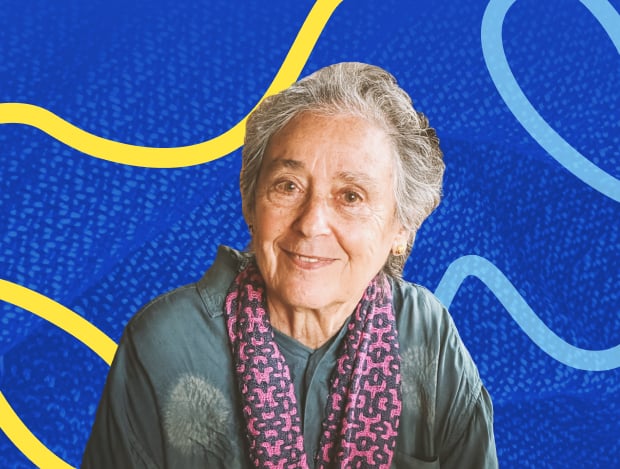
In this interview, we sit down with our 2026 benefit honoree, hand weaver and natural dyer Susan Weltman.
For New York City-based artist Susan Weltman, activism is woven into the fabric of her life. She attended anti-war protests and even participated in the first Earth Day demonstrations in 1970.
That sense of purpose and ethics is also embedded in her work as a hand weaver and natural dyer. She makes things to last, learning from traditional techniques and using natural materials (including indigo grown on her Brooklyn rooftop). And as with weaving, she’s found that activism is an activity best done in community.
Over the years, Susan has become a vital part of the Food & Water Watch community. She joined our successful fight in the 2010s to ban fracking in all of New York state, and contributed many beautiful handmade scarves to our annual benefit auction.
This year, we’re proud to honor Susan at Against All Odds, our annual benefit to protect the planet. And recently, we sat down with Susan to talk about her work and her activism. This interview has been edited for clarity and length.
How did you first become passionate about activism?
I was very fortunate to find the Ethical Culture Youth Group when I was in high school, where I met kids from all over the city (including some of my closest friends who are here with us today). It was with them that I first went to picket Woolworths and joined protest marches against nuclear testing in the early ’60’s.
I also learned from my parents to be not just worried about the world, but to find how I could help to change things. And I always grew up with the idea that people together could make change. I feel so fortunate that I had that message as a kid, and I feel so fortunate that my son and my grandchildren got that message; that they go to demonstrations and are deeply involved in caring about the world.
How does your identity as a weaver connect to your belief in the power of community and collective action?
My grandmother was a seamstress, and my mother sewed. We sewed our own clothing not just because it was less expensive, but because we wanted to be different; to not wear what everyone else was wearing.
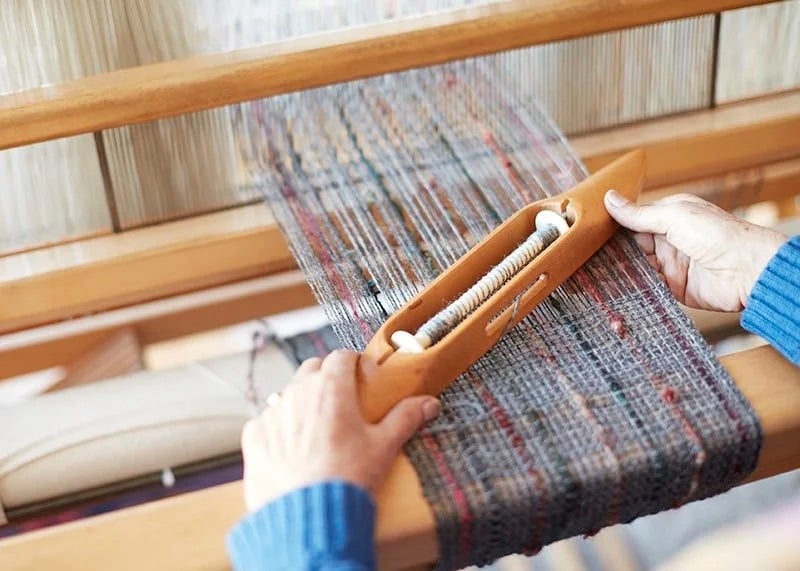
Then, when my son left for college, I started taking weaving classes at the Newark Museum, which drew students from all over New Jersey and New York City, and I found how much I loved the people.
These friends became my “weaving support group,” and this is where I learned that, just as I found a community among my colleagues at the community mental health center and in teaching and writing about family therapy, I could develop a community in the weaving and textile world. And I can’t leave out my connection to Weave a Real Peace, which has been a second home.
Without community, we’re nothing. Without community, we wouldn’t be surviving what we’re going through now.
You’ve contributed several of your scarves to our annual benefit auction. What has that experience been like?
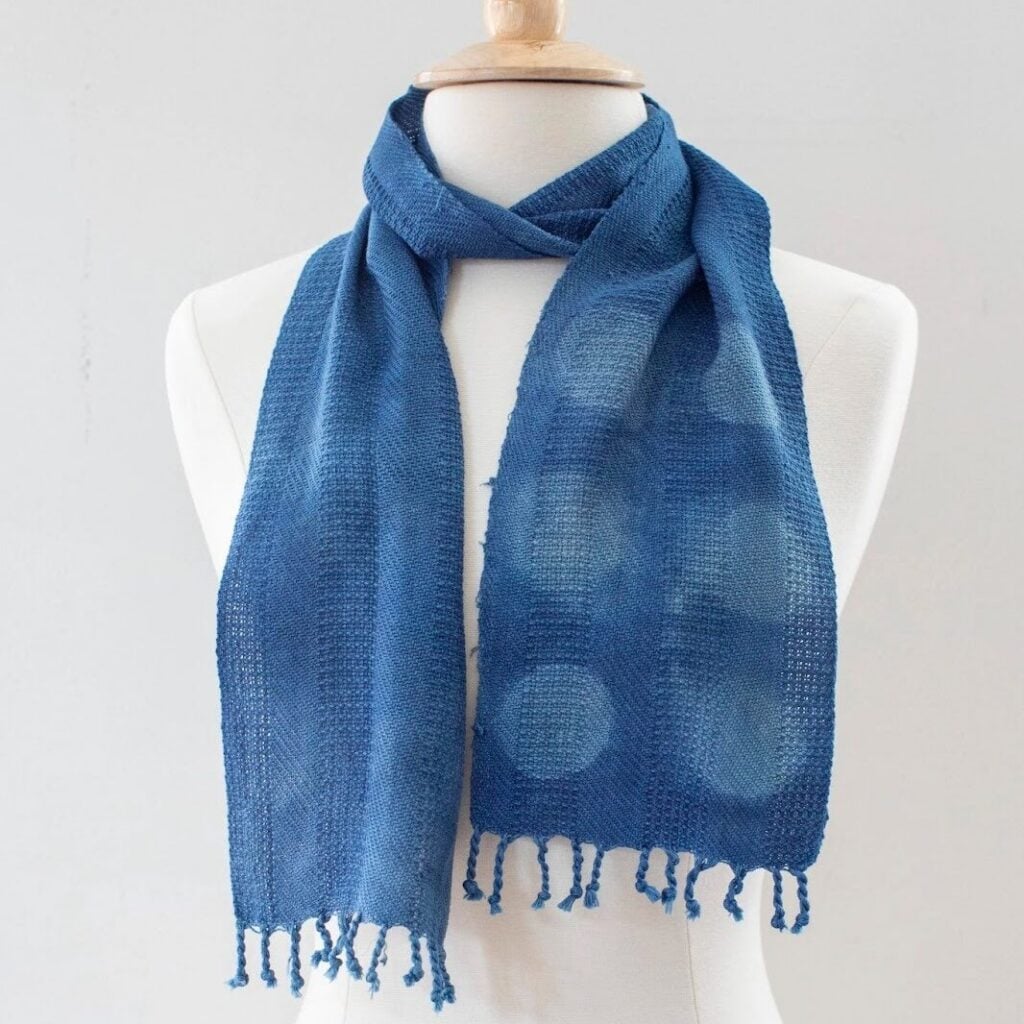
I’ve lived with that scarf for maybe two or three weeks, choosing the colors, choosing the pattern, dressing the loom, weaving it, washing it, ironing it, getting it ready, making the fringe. Then, I go to the event and see who’s interested in it and get to have a conversation with whoever buys it. We talk about why they chose it, what they like about the colors. It’s really a lot of fun.
Many people don’t understand what weaving is, even though most of the clothing people wear has been woven. So it’s also a great opportunity to educate them.
I talk about the love and care that’s gone into creating these scarves or garments. I say to people, “This is silk. It will last forever.” And many people look at me like, “Last forever? I never thought about that.” They’re used to contributing their clothes to a church fund or throwing them out. I love being in the position to tell people that they can hand this scarf down to their children and grandchildren.
In the last two years, my friends and I have been growing indigo on my rooftop in Brooklyn, New York. It was kind of a shock to us how easy it was to do and how much pleasure we get out of it.
One of the items I offer at the auction is an invitation to come with a friend to my home in Brooklyn to dye a scarf and learn about shibori, a kind of Japanese tie dye, and we have an indigo vat prepared. I tell them a little bit about the history of indigo and how it’s special.
So it’s not just the chance to dye a scarf, but also to learn something. And it’s a lot of fun! Part of being part of a larger world is to contribute what I have, what I’ve done, and to spread my joy in textiles with people all over the community.
You’ve been involved with Food & Water Watch for more than fifteen years now. What has that been like?
Going to Food & Water Watch activities and meetings has become a very big part of my life. One of my most wonderful memories was a rally in Albany for a statewide ban on fracking in New York. Pete Seeger was there, who was an incredible hero of mine.
A great thing about Food & Water Watch is that they understand that their volunteers are at different places at different times. You might be able to get out for three demonstrations in a row, and then you might not be able to for several months. But you’re never, ever made to feel like you let them down.
I find some of the meetings just so helpful in this very difficult time, because they’re talking about successes. We often don’t know about what’s happening elsewhere in the country. And when you might have just had a defeat locally, hearing that another community had a success is incredibly important.
What advice do you have for people who are looking for inspiration?
Find your community. Go to meetings, go to rallies, start talking to the people around you.
One of the interesting things about going to the lobby days and the demonstrations is that people are not worn out when they’re there. We can easily be worn out with what’s happening. When you’re watching stuff at home, it’s easy to feel like you’re by yourself. But at a rally or at a meeting, everybody’s at their most energized, even if it’s cold out or rainy, because we’re all in it together.
Recently, we brought a woman who lives in our building to her first demonstration. She had never been to one before, and she was kind of nervous about it.
But afterward, she was so energized. She said, “People are bringing their children, they’re teaching their children that they can have an impact on the world.” And she’s coming to the next demonstration with some of her family members. That means so much to us — that we’re spreading this energy.
You can’t do this alone, you can’t do it by yourself, you can’t do it just by sitting at home. You have to get out there, find your community, and work with them. That’s the only hope for the future.
Hear more from Susan at Against All Odds! Join us in New York City on April 29 at 6 p.m.
Read about our other honorees, filmmaker Matt Wechsler and oil painter Fredericka Foster.
Enjoyed this article?
Sign up for updates.
TO TOP