



Trump’s Tariffs Unauthorized: How Proper Use Can Solve the Farm and Affordability Crisis


Published Feb 20, 2026
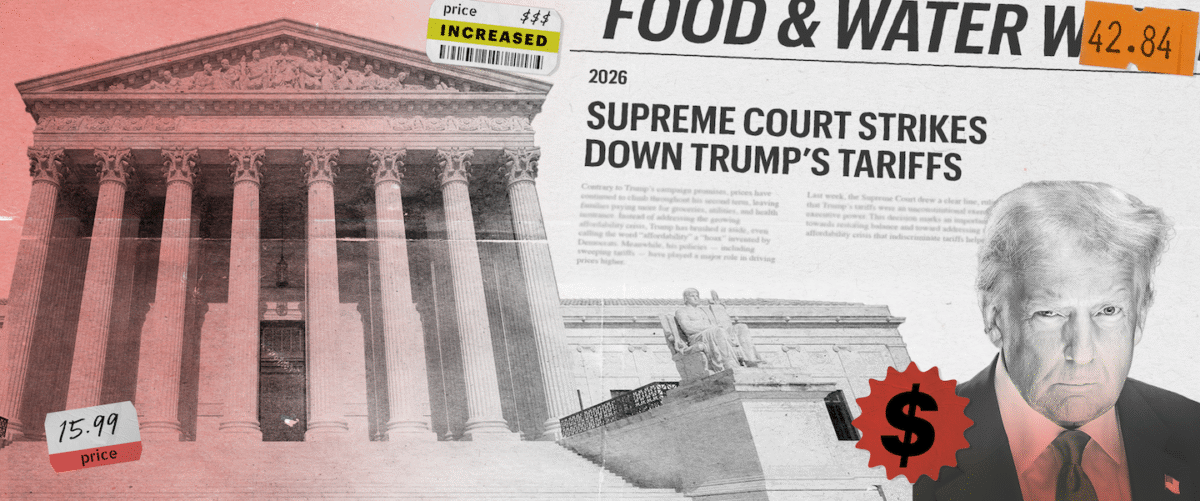
The Supreme Court struck down Trump’s tariffs, but tariffs don’t have to punish; they can support a fair, affordable food system. Here’s how.
Contrary to Trump’s campaign promises, prices have continued to climb throughout his second term, leaving families paying more for groceries, utilities, and health insurance. Instead of addressing the growing affordability crisis, Trump has brushed it aside, even calling the word “affordability” a “hoax” invented by Democrats. Meanwhile, his policies — including sweeping tariffs — have played a major role in driving prices higher.
Today, the Supreme Court drew a clear line, ruling that Trump’s tariffs were not authorized by the International Emergency Economic Powers Act. This decision marks an important step towards restoring balance and toward addressing the affordability crisis that indiscriminate tariffs helped fuel.
But the reality is that tariffs need not be wielded as punishment. When paired with supportive policies, targeted tariffs can help us build a fair food system for farmers and families.
Supreme Court Finds Trump’s Tariffs Unauthorized Executive Overreach
On April 12, 2025, dubbed “Liberation Day”, Trump imposed sweeping, massive tariffs on select countries. Tariffs are taxes on imported goods, paid by importing companies to the importing country, and the Trump administration has repeatedly used them as a blunt instrument of punishment.
By threatening steep tariffs to force countries to comply with his international agenda, the Trump administration disrupted supply chains and injected chaos into global markets. Almost immediately, these tariffs exacerbated the affordability crisis, driving prices up for consumers and increasing rates of farm bankruptcy.
However, as the Supreme Court ruled today, Trump had no authority to issue these sweeping tariffs under the Emergency Economic Powers Act (IEEPA).
The Court slammed the Trump Administration’s interpretation that the IEEPA gave “the President power to unilaterally impose unbound tariffs and change them at will,” stating this view would be a “transformative expansion of the President’s authority over tariff policy.”
Thus, the President cannot use the IEEPA to treat tariffs as unilateral economic weapons, rather than a targeted trade tool, without clear Congressional authorization.
Nevertheless, Trump’s tariff chaos might not be over. He’d already signalled he plans to institute tariffs under different statutes if the Supreme Court decision didn’t come down in his favor. One thing is clear: Trump’s tariff tantrum will not end with this court ruling.
Trump’s Unauthorized Tariffs Deepened the Affordability Crisis
If prices at the grocery store feel higher, it’s because they are. Despite repeated claims by the Trump administration that tariffs force other countries to “pay up,” the real costs have fallen on U.S. families and farmers.
By October 2025, exporting companies were paying only about 18% of tariff costs. U.S. importers shouldered about 27% of tariff costs, while American consumers were burdened with a shocking 55%, paid through higher prices at the checkout line. By December 2025, tariffs cost the average U.S. household $1,200.
Prior to this Supreme Court decision, analysts estimated that by mid-2026, American consumers would pay as much as 67% of tariff costs, while foreign exporters would pay only a minuscule fraction. Groceries and everyday essentials are creeping out of reach for the average American due to staggeringly high prices caused by Trump’s tariff tantrum and disastrous deregulatory, pro-corporate policies.
Trump’s Tariffs Wreaked Havoc for Small and Medium-Sized Farmers
Consumers aren’t the only ones feeling the pain of Trump’s tariffs. Small and medium-sized farmers are facing bankruptcy. During Trump’s first term, broad, punitive tariffs sparked trade wars that harmed farmers dependent on export crops like soybeans and quietly strengthened the hand of agribusiness giants. While small farms shuttered, Big Ag benefited from Trump’s bailouts.
In his second administration, Trump’s tariffs were even more far-reaching. Notably, they also raised the prices of agricultural inputs, like chemicals and machinery, that farmers import from other countries.
From February through October 2025, $958 million in revenue came from tariffs on these inputs. This is not an abstract number; it represents higher costs for farmers buying the tools they need to grow food, as well as the downstream impact of higher food prices on consumers.
This administration likes to tout its bridge payments (payouts to farmers impacted by tariffs), but throwing money at farmers does not fix the structural damage these tariffs cause. Agribusinesses are still paying higher tariffs on imported materials and then passing those costs onto farmers and consumers.
This cycle rewards large agribusinesses that can absorb the rising costs and volatility, while draining small farmers already operating on razor-thin margins and consumers already struggling to pay bills. Trump’s tariffs have wreaked havoc on our food system, but it doesn’t have to be this way. Strategic tariffs paired with good policy can foster stronger domestic industries, lower prices, and a fairer food system.
How Tariffs Can Support a Fair Food System
This Supreme Court decision doesn’t mean that tariffs will disappear, and they shouldn’t. The problem has never been the tariffs themselves, just how the Trump administration uses them.
Strategic use of tariffs can discourage labor abuses and environmentally harmful practices in exporting countries. They can also protect and level the playing field for U.S. industries by raising the prices of artificially cheap imports. But targeted tariffs alone won’t solve all challenges; they must be partnered with other policies that address the root causes of our unfair food system.
One of those root causes is the decades of unchecked overproduction in the U.S. Farmers grow massive amounts of crops, in great part for export, which leaves farmers and consumers vulnerable to large, volatile price swings. This overproduction problem has helped consolidate the industry, squeezing out small farmers until only the biggest and richest agribusinesses remain.
Supply management policies would go a long way in fixing this. For example, reintroducing grain reserves would help keep prices stable for farmers and consumers by allowing the government to purchase grain when supply is high, or when prices crash, and sell the grain when supply is low and prices are stable.
Pairing these grain reserves with price floors would ensure that farmers earn a livable income rather than overproducing just to keep their heads above water, which has helped Big Ag drive a race to the bottom.
Additionally, expanding and improving conservation programs could help farmers reduce overproduction while investing in soil health and water protection. These programs have shifted to benefit Big Ag, but lawmakers can and must reframe them in the next Farm Bill to serve small and mid-sized farms as they were originally intended.
Food & Water Watch shares the information you need to defend our food, water, and climate from corporate greed. Get our latest updates in your inbox!
Strategic tariffs can also help address the affordability crisis by preventing sudden surges of cheap imports and dumping of products sold at below production cost, which can destabilize markets and push farmers out of business.
When combined with smart supply management policies, tariffs can help better balance how much food we import and produce with how much people actually need. This prevents the kind of overproduction that bankrupts farmers, fuels consolidation, and causes shortages and price spikes for consumers.
We Need a Better Path Forward for Farmers and Families
Today’s Supreme Court decision is an essential check on executive authority. The President cannot impose these sweeping tariffs under the IEEPA.
It’s no secret that our food system is in crisis. While families face skyrocketing prices at the grocery store, small and medium-sized family farmers are shuttering. The only winners here are Big Ag corporations — and Trump’s tariffs only make it worse.
Strategic tariffs with protective supply management policies are powerful tools to fix this crisis. While Trump seems determined to continue wielding his tariffs in punitive, senseless, and chaotic ways, our leaders shouldn’t forsake an important tool just because of Trump’s misguided use.
The time to lay the groundwork for a fair food system is now. Lawmakers can improve domestic farm and industrial policies through a fair Farm Bill, but they must stop bending to Big Ag and start prioritizing policy that centers consumers and small and mid-sized farmers. Ultimately, it will take transformative policy change — which includes smart tariffs — to build a system that puts farmers and families before Big Ag.
Enjoyed this article?
Sign up for updates.
TO TOP