



Guide to Safe Tap Water and Water Filters

Published Feb 16, 2016
Drinking tap water should be safe, affordable, and taste good. Follow our guide to check your tap water quality and find the best filtration system for you.
Update (Nov. 15, 2023):
This guide has been updated with new information on filtering PFAS.
Drinking tap water should be safe, affordable, and taste good. Follow our guide to check your tap water quality and find the best filtration system for you.
The word is out: bottled water can be bad for our wallets, our health and our environment. If you’re among the growing number of people kicking the bottled water habit and making the move to tap water, you may be curious about your local water supply. Consumer standards are actually more stringent for the quality and safety of tap water than for bottled water.
The best way to find out about your local water is to read your water quality report, a document that your water utility is required by federal law to provide to you every year telling you if your water has any contamination. This guide will help you understand how to interpret what your report tells you.
Beyond basic safety, many people prefer to filter their tap water to remove minerals and particulates, which may affect the taste. We’ll walk you through the different types of tap water filters and help you pick the best one for your needs.
Table of Contents
- Your Water Quality Report
- How to Read Your Water Quality Report
- Tap Water Filters and Filtration Systems
- Consider Which Filter is Best for You
- Worried About PFAS?
- Act for Safe Water
Your Water Quality Report
Annual water quality reports, also called consumer confidence reports, are intended to help consumers make informed choices about their drinking water. They let you know what contaminants, if any, are in your drinking water and how these contaminants may affect your health. They list all the regulated toxins that were detected in your water over the preceding calendar year. This guide will help you understand what’s in your water quality report and how to interpret what it tells you.
Who Gets a Water Quality Report?
A water quality report is available for every customer of a community water system, which is one that provides year-round service to more than 15 households or more than 25 people.
When Is a Water Quality Report Issued?
You should receive your report by July 1 of each year.
How to Read Your Water Quality Report
What Does a Water Quality Report Tell You?
Every water quality report must contain:
- The source of the drinking water, be it a river, lake, groundwater aquifer or some other body of water;
- A brief summary of the state’s source water assessment, which measures how susceptible the source water is to contamination, and how to get a copy of the complete assessment;
- The U.S. Environmental Protection Agency (EPA) regulations and health goals for drinking water contaminants;
- A list of all detected regulated contaminants and their levels;
- Potential health effects of any contaminant detected at a level that violates the EPA’s health standard;
- An educational statement for people with weakened immune systems about cryptosporidium and other microbial contaminants;
- Contact information for the water system and the EPA’s Safe Drinking Water Hotline.
Why Is a Water Quality Report Important?
Your water utility is required by law to tell you about any violation of EPA water quality standards when it occurs (through the mail or media outlets such as newspapers and television) and again in the annual water quality report. You should not drink water that fails to meet EPA standards because it may be unsafe. Thankfully, public utilities have worked hard to improve water quality. As a result, more than 90 percent of water systems meet all EPA regulations.
The report must also disclose a list of all regulated contaminants that have been detected in the water supply. The Safe Drinking Water Act sets the maximum level of contaminants allowed in drinking water based on the filtering and treatment capabilities of current technology. The water quality report also tells you about potentially harmful substances found in your water at levels below their legal limit.
Tip: Hover your cursor over or tap the underlined text in the charts below for more information about these areas of your water quality report.
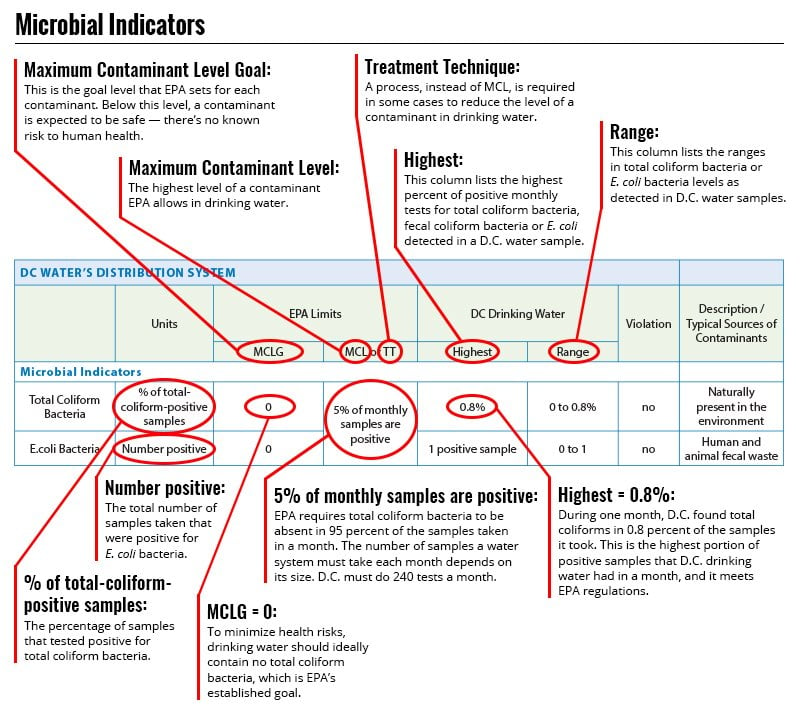
Microbial Indicators
| DC WATER'S DISTRIBUTION SYSTEM | |||||||
|---|---|---|---|---|---|---|---|
| Units | EPA Limits | DC Drinking Water | Violation | Description / Typical Sources of Contaminants |
|||
| MCLG | MCL or TT | Highest | Range | ||||
| MICROBIAL INDICATORS | |||||||
| Total Coliform Bacteria | % of total-coliform-positive samples | 0 | 5% of monthly samples are positive | 0.8% | 0 to 0.8% | no | Naturally present in the environment |
| E.coli Bacteria | Number positive | 0 | 1 positive sample | 0 to 1 | no | Human and animal fecal waste | |
| DC WATER'S DISTRIBUTION SYSTEM | |||||||||||||||||||||||||||||
|---|---|---|---|---|---|---|---|---|---|---|---|---|---|---|---|---|---|---|---|---|---|---|---|---|---|---|---|---|---|
| MICROBIAL INDICATORS | |||||||||||||||||||||||||||||
| Total Coliform Bacteria | |||||||||||||||||||||||||||||
|
|||||||||||||||||||||||||||||
| E.coli Bacteria | |||||||||||||||||||||||||||||
|
|||||||||||||||||||||||||||||
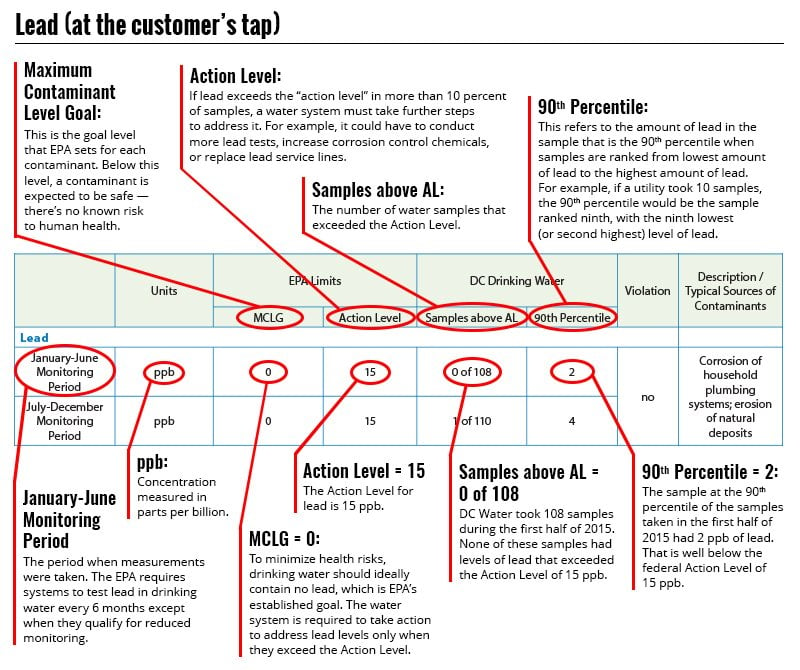
Lead
| LEAD | |||||||
|---|---|---|---|---|---|---|---|
| Units | EPA Limits | DC Drinking Water | Violation | Description / Typical Sources of Contaminants |
|||
| MCLG | Action Level | Samples above AL | 90th Percentile | ||||
| January-June Monitoring Period |
ppb | 0 | 15 | 0 of 108 | 2 | no | Corrosion of household plumbing systems; erosion of natural deposits |
| E.coli Bacteria | Number positive | 0 | 15 | 1 of 110 | 4 | no | |
| LEAD | |||||||||||||||||||||||||||||
|---|---|---|---|---|---|---|---|---|---|---|---|---|---|---|---|---|---|---|---|---|---|---|---|---|---|---|---|---|---|
| January-June Monitoring Period | |||||||||||||||||||||||||||||
|
|||||||||||||||||||||||||||||
| July-December Monitoring Period | |||||||||||||||||||||||||||||
|
|||||||||||||||||||||||||||||
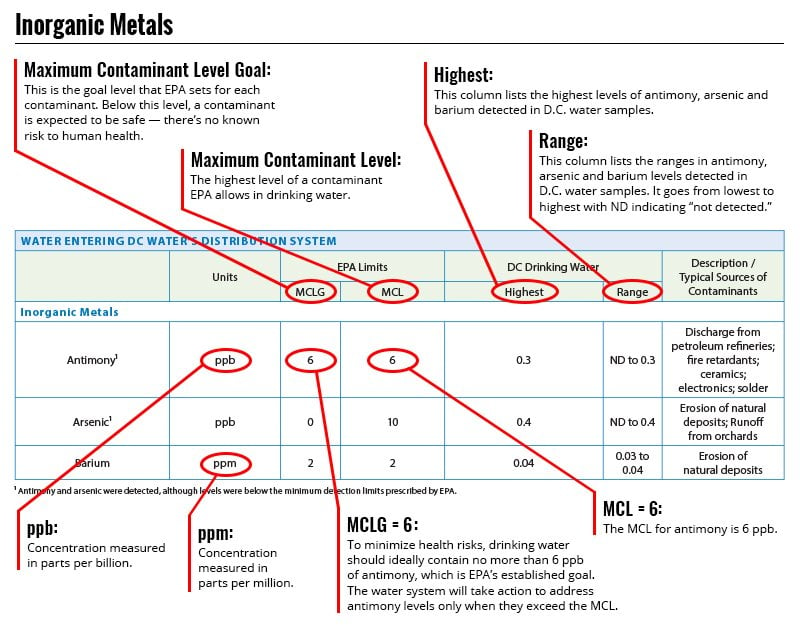
Inorganic Metals
| WATER ENTERING DC WATER'S DISTRIBUTION SYSTEM | |||||||
|---|---|---|---|---|---|---|---|
| Units | EPA Limits | DC Drinking Water | Description / Typical Sources of Contaminants |
||||
| MCLG | MCL or TT | Highest | Range | ||||
| INORGANIC METALS | |||||||
| Antimony | ppb | 6 | 6 | 0.3 | ND to 0.3 | Corrosion of household plumbing systems; erosion of natural deposits | |
| Arsenic | ppb | 0 | 10 | 0.4 | ND to 0.4 | ||
| Barium | ppm | 2 | 2 | 0.04 | 0.03 to 0.04 | ||
| WATER ENTERING DC WATER'S DISTRIBUTION SYSTEM | |
|---|---|
| INORGANIC METALS | |
| Antimony | |
| Arsenic | |
| Barium | |
How Is a Water Quality Report Distributed?
All very large community water systems, serving more than 100,000 people, must post the report online. All community water systems that serve more than 10,000 people must mail or email either the report or its web address to customers.
Water systems also must make a “good faith effort” to reach renters, workers and other consumers who use the water but do not receive water bills. Utilities should use a combination of different outreach methods to notify users, such as posting the reports online, mailing them and advertising in local newspapers.
More information is available online from the EPA.
Tap Water Filters and Filtration Systems
The United States provides some of the cleanest drinking water in the world, and more than 90 percent of water systems meet all EPA regulations. Some people may prefer to filter their tap water, however, because they prefer the taste, want to remove minerals and particulates or have concerns about lead piping and plumbing. This section highlights the types of available filters to help you to determine which one is best for your needs.
What to Consider When Buying a Water Filter
What impurities do you want to remove from your water? Are you concerned about health risks, or simply unappetizing tastes and odors? Different filters are designed to remove various impurities, so be sure that the filter you buy will do the job.
Once you have read your water quality report, determine what, if anything, you would like to filter out of your water. Depending on the water quality where you live, you may decide that you do not need to filter your water at all.
Water Filtration: What Are Your Options?
Water filters come in many shapes and sizes. Depending on your filtration needs, lifestyle preferences and budget, you may want to consider the following options, whose descriptions were adapted from a May 2010 Consumer Reports article:
Water Filter Technologies
Different water filter products use different technologies. Some use more than one. If you are looking for a home water filter, you are likely to come across some of these terms:
Consider Which Filter Is Best for You
Each product has its own pros and cons. Individual products may use multiple technologies and are often marketed as two (or more) stage filters. Carafe, faucet-mounted and countertop filters typically use a combination of adsorption and ion exchange resins, while plumbed-in systems may use those technologies in addition to reverse osmosis.
Filters also come in a wide range of prices. Most carafes and faucet-mounted filters cost between $20 and $50, while countertop, under-sink and whole-house filters can range from $50 to $900.
When considering the price of a water filter, remember that the total cost includes your initial purchase price as well as any installation, maintenance or replacement fees. Filter parts need to be changed periodically to prevent clogging, so be sure to consider how much replacement parts cost, as well as the manufacturer’s estimated life span for the product.
Also consider the amount of water you use. Some filter types have larger water capacities than others. Carafes, for example, can filter a few cups or gallons at a time, while faucet-mounted or under-sink filters work directly through a tap.
Most importantly, make sure that the individual product reduces the specific contaminants that you want to remove from your water. Generally, products will include claims on their packaging or advertising regarding which contaminants they reduce and the percentage reduction rate. See the table below for more information about common contaminants of concern and which type of filter will reduce the contaminants.
Water Quality Concerns and Filtration Methods*
| Contaminant/Quality Concern | Filtration Method | Notes |
|---|---|---|
| Chlorine | Carbon/Charcoal Filter | Contact your local water utility to find out which disinfectant is used in your drinking water. Water filters certified to reduce chlorine do not necessarily work for chloramine. |
| Chlorine Byproducts (Trihalomethanes) | Carbon/Charcoal Filter | Trihalomethanes are a type of VOC (volatile organic compound), so products certified to reduce VOCs will reduce this contaminant. |
| Taste and Odor | Carbon/Charcoal Filter | |
| Lead | Carbon, Distillation, Reverse Osmosis | |
| Fluoride | Distillation, Reverse Osmosis | Not all public drinking water systems add fluoride to the water. Check to see if your community does by reading your annual water quality report. |
| Chloramines | Some Carbon/Charcoal Filters | Check that the system you select is certified to reduce chloramines. Systems that reduce chlorine do not necessarily reduce chloramines. |
| Perchlorates | Reverse Osmosis | |
| Arsenic | Distillation, Reverse Osmosis | Two different forms of arsenic can be found in water, so it is important to know which type of arsenic you want to filter before choosing a water treatment system. |
| Contaminant/Quality Concern | ||||
|---|---|---|---|---|
| Chlorine | ||||
|
||||
| Chlorine Byproducts (Trihalomethanes) | ||||
|
||||
| Taste and Odor | ||||
|
||||
| Lead | ||||
|
||||
| Flouride | ||||
|
||||
| Chloramines | ||||
|
||||
| Perchlorates | ||||
|
||||
| Arsenic | ||||
|
*Information taken from National Sanitation Foundation’s Contaminant Guide. Please note that filters and treatment systems should be certified by a third party agency. Check to ensure that the brand of filter you choose is certified to address your water quality needs.
Worried about lead? Make sure you get the right water filter.
The crisis in Flint, Michigan has brought attention to the serious problem of lead in drinking water. Fortunately, a water filter that is either NSF/ANSI Standard 53 or NSF/ANSI Standard 58 certified can reduce lead in your drinking water. These certifications are established by NSF International, a public health organization that develops standards and providing certifications with the mission to improve global human health.
These certified filters come in different shapes and sizes. Certification requires that manufacturers state how much water the filter can treat before it must be changed. Some filters even include a device that will let you know when the filter needs to be changed. When changing filter cartridges, it’s important to use a certified cartridge. A non-certified cartridge may not effectively filter lead from the drinking water.
There are a variety of filter options that meet the NSF’s certified standard. Outlined below, these filters include: pour-through pitchers/carafes, faucet mounts, and even plumbed-in filters that are installed under your sink or reverse osmosis drinking water treatment systems.
On the NSF website at www.nsf.org you can search for specific suppliers and product codes to see if they are NSF certified. Their lead specific guide provides a list of all NSF Standard certified brands and models with details for each: www.nsf.org/info/leadfiltrationguide.
Pharmaceuticals, Personal Care Products, Pesticides, Hormone-Disrupting Chemicals, and Microplastics
Consumers are increasingly concerned about pharmaceuticals, pesticides, other hormone disrupting chemicals and microplastics in drinking water. These chemicals are not regulated, but studies have shown that they are showing up in trace amounts in drinking water. According to the National Sanitation Foundation, filters with NSF/ANSI 401 certification can reduce levels of at least one of 15 types of emerging contaminants from drinking water. You can search by the chemical of concern on the NSF website.
Verify the quality of Your Filter
Make sure that your filter is certified by an independent certifying agency. Not all filters live up to the claims on the package, so make sure that the product you are buying does. The packaging should display certification from an independent certifying agency such as the National Sanitation Foundation International or Water Quality Association.
Check the internet for product reviews, and make sure the reviewer is impartial. The best reviews and ratings come from organizations that do not sell the products, such as Consumer Reports. Consumer Reports is published by Consumers Union, a nonprofit organization that provides consumers with unbiased product tests and ratings.
Worried About PFAS?
PFAS (per and polyfluoroalkyl substances) are a class of thousands of toxic lab-made chemicals that are pervasive in consumer goods, such as nonstick cookware and stain-resistant carpets. They are known as “forever chemicals” because they do not break down in the environment.
PFAS have been linked to a large range of health problems including various cancers, altered hormone levels, decreased birth weights, digestive inflammation, and reduced vaccine response. New research comes out almost every day that indicates no amount is safe.
Is PFAS in your tap water?
Nearly half of the nation’s tap water is contaminated with PFAS. You can check your annual water quality report for detectable levels of certain PFAS, if your water comes from a mid-size or larger water system. All community water systems serving more than 10,000 people and a selection of smaller systems are required to test for 29 forms of PFAS, and if any of these toxic compounds are detected, those results will be listed in the water system’s annual water quality report.
In March 2023, the Environmental Protection Agency proposed the first ever set of enforceable standards for several PFAS, and although those are not finalized yet, several individual states have already set their own enforceable standards.
If your state regulates certain forms of PFAS, detected levels will be included in your annual water quality report. No state regulates the entire class of PFAS.
Do you have a household water well?
The EPA and state governments do not regulate drinking water quality of private water wells. There are often local laboratories that will be able to conduct PFAS water testing for an out-of-pocket cost. We recommend using state-certified labs for the most accurate results.
What can I do to remove PFAS from my tap water?
The most effective home filtration system is a reverse osmosis filter (NSF 58). These are usually under the sink or plumbed-in filters, and they are more expensive than other types of filters.
A 2020 study found, “All under-sink dual-stage and reverse osmosis filters tested showed near complete removal for all PFASs evaluated.” Activated carbon filters, such as those found in pitchers or refrigerators, however, failed to reliably remove all PFAS, particularly shorter chain PFAS like GenX.
PFAS have also been detected in bottled water, with higher levels in spring water than purified water (which is often reverse osmosis-filtered tap water), and there are currently no standards that regulate PFAS in bottled water.
Act for Safe Water
You can help protect your household from water contamination by understanding your water quality report and finding a filter that meets your needs. We also need to advocate for policies to protect our invaluable water resources in the first place and ensure that every person, regardless of their income, race, or neighborhood, has access to safe water.
That is why Food & Water Watch is fighting the worst corporate water abusers, including the fracking and fossil fuel industry, factory farms, and PFAS polluters. Safe water is out of reach for many communities, particularly rural areas and communities of color, often because corporations have polluted or overused water supplies.
Every person deserves safe, affordable, public water. The Water Affordability, Transparency, Equity and Reliability (WATER) Act is part of the solution. It would guarantee a permanent federal commitment to update aging water infrastructure, remove toxic lead pipes and PFAS from water, and provide the resources necessary to help ensure safe water in every community.
Everybody needs safe water. Support the WATER Act!


Enjoyed this article?
Sign up for updates.
TO TOP