



How Cyclospora Exploded Across the U.S. This Summer


Published Aug 11, 2026
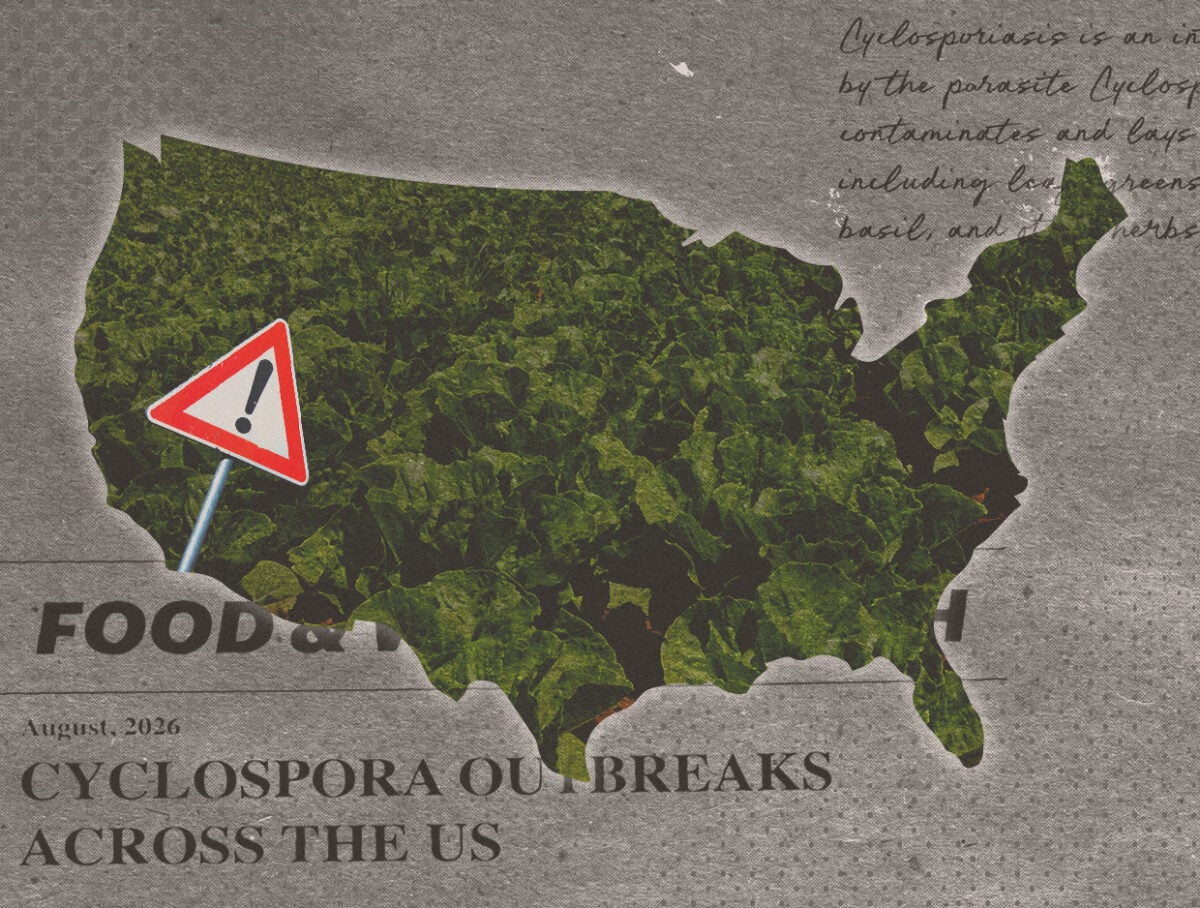
This summer, the U.S. faced the biggest Cyclospora outbreaks in history. How did this happen, and how can we avoid more outbreaks in the future?
For many, summer is a time for refreshing salads, burgers with lettuce, and fresh berries. But multiple growing outbreaks of cyclosporiasis are draining that summer fun, forcing people to look at fresh produce and wonder, “Will this give me explosive diarrhea?”
These outbreaks, now making up the biggest in U.S. history, weren’t inevitable. They’re linked to Trump’s funding cuts, Big Ag’s control of our food supply, and yes, even climate change.
This cyclosporiasis outbreak is a bright red, flashing warning light. Without quick action and systemic changes to our food system, the next outbreak could be much, much worse.
What Brought This Sh*t On?
Cyclosporiasis is an intestinal infection caused by the parasite Cyclospora cayetanensis. It contaminates and lays eggs on produce including leafy greens, raspberries, snow peas, basil, and other herbs. Eating those eggs can cause us intestinal pain, low-grade fever, explosive diarrhea, and other medical problems.
From May 1 to August 4, the CDC confirmed over 10,000 lab-tested cases of cyclosporiasis and 517 hospitalizations. Forty-seven states are reporting cases, with the largest outbreak spanning fifteen states. 1MI, OH, NC, IL, IN, KY, WV, KS, MO, IA, NE, NH, PA, OK, AR Michigan health officials have reported over 12,000 cases in that state alone. In August, Michigan reported the first and second deaths from this outbreak.
Handwashing and washing produce aren’t entirely effective in eliminating Cyclospora — only cooking produce to at least 158 degrees Fahrenheit can kill the parasites. That, plus the ongoing confusion on where these outbreaks originated, has contributed to this summer’s continuing unease around leafy greens and other produce.
Overwhelming evidence for the Midwest outbreaks points to shredded iceberg lettuce from Taylor Farms de Mexico. Taylor Farms is not a new name in food safety headlines. In fact, from 2009 to 2026, its products have been implicated in more than a dozen foodborne illness outbreaks, ranging from deadly E. coli outbreaks to Listeria, Cyclospora, and Salmonella.
Just this month, in addition to their connection to the historic Cyclospora outbreak, Taylor Farms is now involved in a Salmonella outbreak affecting 27 states and about 345 people. This summer of sickness highlights the role Taylor Farms has played in sickening thousands of individuals across the United States over the years, with little to no significant repercussions from the federal government.
How Trump’s Cuts Made This Cyclospora Outbreak Worse
The U.S. has established programs designed to study, track, and help contain foodborne illnesses. But in recent years, funding for these programs has failed to keep up with the need. And the Trump administration has only made things worse by slashing staff and funding.
The Trump Administration cut key grant and funding programs that state health departments rely on to track foodborne illnesses. Last year, due to staffing cuts, the Administration paused a quality control program conducted through the FDA’s Food Emergency Response Network (FERN) at least through September 2025. This program included quality control work on lab testing for Cyclospora in spinach. It’s unclear whether the program is back up and running today
FERN’s system of federal, state, and local laboratories defends and responds to contamination in the food supply. It tests food samples during large-scale outbreaks to help identify the source of contamination.
Meanwhile, at the CDC, Trump’s budget and staffing cuts have led to downgrades to the FoodNet program. FoodNet tracks long-term trends in foodborne illness rates across ten states. But with Trump’s cuts, FoodNet was forced to stop tracking six of the eight pathogens it has historically tracked. Cyclospora was one of the six on the chopping block.
Collectively, those six pathogens cause an estimated 111,000 hospitalizations and 418 deaths each year. One of them, Campylobacter, causes up to $6.8 billion in economic damages every year.
Rather than Make America Healthy Again, Trump’s cuts show blatant disregard for food safety and public health. Quick and comprehensive data collection is an essential line of defense in detecting and containing foodborne illness outbreaks — without it, we’re left fighting in the dark.
Tell Congress: Fully fund food safety and protect our food and public health!
Big Ag’s Dominance = More Foodborne Illness
This Cyclospora outbreak also highlights the dangers of our corporate-controlled, highly consolidated food system. Lettuce and leafy greens are common causes of foodborne illness because most are irrigated using polluting substances, or they’re produced near disastrously polluting factory farms.
Factory farms are a huge culprit of this contamination problem. These facilities exist to make raising livestock as cheap as possible for the sake of corporate profits, storing up to a million animals in tight confines. Leafy greens grown near factory farms are regularly exposed to pathogens in the waste that these facilities produce in abundance.
Cyclosporasis in particular spreads via human waste, and Big Ag has long-spread sludge from human sewage on agricultural land as fertilizer.
Moreover, as the industry searches for more water sources, it’s increasingly turned to “recycled” wastewater. While this water moves through treatment plants before it hits fields, that’s often not enough to make it totally pathogen-free. Studies have shown that bacteria and pathogens persist in wastewater after treatment, and research suggests that “using treated wastewater for agricultural irrigation may cause food chain contamination.”
These dangerous business practices aren’t the only way Big Ag is driving more foodborne illness. Taylor Farms, the corporation at the heart of today’s largest Cyclospora outbreaks, has acquired or invested in 10 other companies in just eight years. It runs 22 production facilities in North America and sells 40% of “value-added salads” in the United States.
This consolidation — fewer and bigger companies controlling more of our food — makes our food system even more vulnerable to shocks. Now, Cyclospora shows us the outsized influence a single company can have because of its massive reach. A single corporation can send an illness across the country.
In short, our profit-at-any-cost, highly consolidated food system trades public health for corporate gain.
Climate Change Makes Everything Worse, Including Cyclospora
Since the 1990s, cyclosporiasis outbreaks have occurred each year, typically from May through August. As climate change makes summers hotter and longer, the window for Cyclospora to spread also widens, as the parasite thrives in warm, humid conditions.
Studies also show that climate change and climate disasters will cause more food spoilage and foodborne illnesses. Hotter temperatures promote the growth of pathogens such as Listeria, Campylobacter, and Salmonella, while floods can contaminate food supplies with sewage and agricultural runoff.
Moreover, as climate change drives more and longer droughts, the USDA will likely encourage farms to turn to wastewater as a solution. The agency has called treated wastewater “the irrigation wave of the future.”
Right now, our corporate-dominated food system is utterly unprepared for how climate change will impact our food. While government agencies recommend we irrigate our crops with wastewater, Trump is demolishing climate and public health programs and funding.
Cyclospora is sending us a dire warning that our leaders must heed: We need to invest in public health, climate change response, and a sustainable, diverse food system that bucks corporate control. Or they’ll guarantee another foodborne illness outbreak, rather than making Americans healthy.
Enjoyed this article?
Sign up for updates.
TO TOP
Endnotes