



What Leaders Must Do to Tackle Iowa’s Drinking Water Crisis


Published Dec 10, 2025
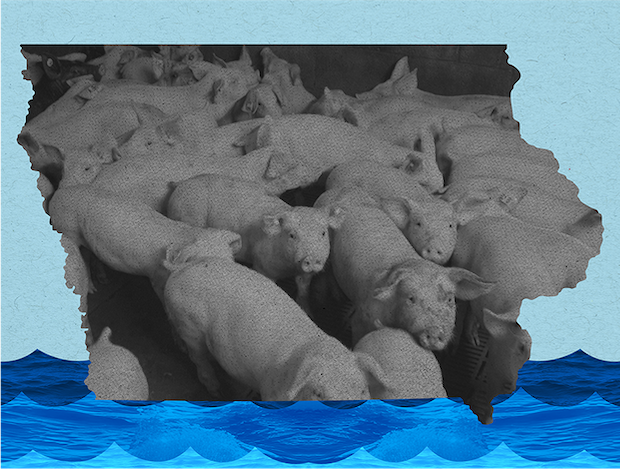
Iowa policy has long-failed to address the factory farm pollution poisoning the state’s drinking water. Here’s the blueprint for how lawmakers can change this.
In Iowa, Big Ag’s pollution problem has reached crisis levels. Pollution from factory farms — massive warehouses stuffed with livestock — is a major contributor. But the state’s leaders have failed to address this problem, letting Big Ag off the hook for its harms. Iowans are paying the price.
Factory farms’ pollution is linked to a variety of health harms, including cancer. It’s adding to water treatment costs, making drinking water more expensive, and keeping Iowans out of the rivers and lakes they love. With their inaction, lawmakers are effectively sacrificing Iowans for Big Ag’s bottom line. They can and must change course. Our comprehensive policy blueprint shows how.
Factory Farms and Iowa’s Nitrate Pollution Crisis
The main driver behind Iowa’s water crisis is nitrate-rich pollution from the massive amounts of waste factory farms produce. These factory farms operate as sewerless cities, spewing pathogens, pharmaceuticals, and chemical-laden waste into waterways and onto over-saturated fields. Much of it ends up in the water.
Now, after decades of irresponsible, cost-cutting manure disposal, Iowa’s water quality has quite literally gone to shit. Our analysis finds that Iowa’s factory farms produce 109 billion pounds of manure waste a year, 25 times that of the state’s human population.
The nitrates in that staggering amount of waste are especially damaging to people’s health. When ingested, nitrate converts to N-nitroso compounds, most of which are cancer-causing. Nitrate ingestion is also linked to a variety of health conditions, including potentially fatal blue baby syndrome and worsened thyroid disease.
Now, Iowa is one of only two states in the nation with rising cancer rates. The Iowa Cancer Registry estimates that Iowa families saw a staggering 21,200 cancer diagnoses in 2025. The time to address this crisis head-on has long passed.
Iowa Allows Factory Farms to Pollute with Impunity
Rather than hold factory farms accountable for their pollution, Iowa has relied on voluntary programs — facilities can choose to reduce their pollution, or they can simply not.
Data demonstrate that this strategy isn’t working. In fact, independent analysis by the Iowa Environmental Council indicates that, at the current pace of implementation, it will take Iowa tens of thousands of years to reach its water quality goals. Moreover, the state fails to consistently fund regulators that are supposed to watchdog polluters and defend clean water.
The results are clear: worsening pollution with lessening oversight. Our analysis found that Iowa factory farms paid less than $750,000 in penalties for ten years of pollution. Meanwhile, experts estimate public drinking water cleanup costs have skyrocketed to an estimated $66 million annually.
It doesn’t have to be this way. Corporate lobbyists and corrupt politicians have long written off pollution as an inevitable price of being an agricultural state. But that’s a lie.
A 2025 Polk County water report found that nitrate concentrations in Iowa waterways are the highest in the nation. Meanwhile, other agricultural states, like Minnesota, don’t face nearly the same crisis. Though Minnesota’s approach isn’t perfect, the proportion of people facing elevated levels of nitrate pollution in their water is far lower there than in Iowa.
But Minnesota’s water quality isn’t a miracle — it’s the result of decision makers in Minnesota adopting common-sense policies that actually rein in agricultural pollution. Iowa leaders can and must pass a suite of such policies to defend clean water and public health for Iowans. Here’s what that looks like:
Our Blueprint for Clean Water for Iowa
1. Require Good Manure Management Practices
Iowa’s refusal to mandate science-backed solutions only deepens the problems with factory farms. The state’s water crisis shows that these can’t be optional — state lawmakers must mandate them.
For example, we know the state’s geology makes it especially easy for pollutants to trickle down into drinking water sources deep underground. Iowa should ban new factory farms from being built in vulnerable areas.
We also know leaks from factory farm manure lagoons are a common source of pollution. Iowa should require factory farms to build better lagoons to stop leakage.
And factory farms often “dispose” of their waste by spreading it on fields, supposedly as fertilizer. But this is hollow reasoning when they regularly spread on oversaturated fields and even fields frozen solid in the winter. This makes it much easier for waste to run off into water sources. Factory farms shouldn’t be able to spread their waste in such harmful ways.
We’ve pinpointed hard numbers and specific statutes that need to be changed. Check out the full details in our factsheet, “Iowa Blueprint for Clean Water.”
2. Mandate More Transparency from Factory Farms on Their Pollution
Rather than look at the nitrate crisis head-on, state lawmakers have put on a blindfold. In 2023, they defunded Iowa’s real-time water monitoring system. It will shut down in summer 2026.
Without statewide water quality monitoring, the only information available to the public and decision makers about Iowa water quality would come from factory farm polluters themselves. Recent state budget cuts have slashed the Department of Natural Resources’s (DNR) capacity for inspections and enforcement to ensure factory farms are actually telling the truth.
Even for the waste spills that factory farms do report, the DNR does not require them to share information about volume or just how much got into waterways. And for the relatively few factory farms that do detect, monitor, and report information about their operations, the amount of manure they produce and spread is shrouded in secrecy by the DNR.
Blocking access to water quality data will not make the problem go away; rather, it will only guarantee that the public is at higher risk. Iowa leaders must change course.
They can start by requiring more inspections, permanently funding real-time monitoring, and funding and staffing the DNR to increase inspections, reporting, and enforcement.
3. Hold Corporate Polluters Accountable with Permitting
Iowa’s weak factory farm regulations ignore the obvious: corporations will always put profits before people and the environment. While some of the state’s factory farms are required to get construction permits, more than 4,000 medium-sized and large factory farms are operating in Iowa without any water pollution oversight.
The DNR assumes these factory farms don’t pollute, despite lots of evidence to the contrary. State leaders must face reality: factory farm pollution is a massive driver of Iowa’s water crisis. And the only way to change that is to hold them accountable by requiring pollution permits.
Leaders can do this by passing the Clean Water for Iowa Act (SF 183). This would require water pollution permitting and monitoring at the thousands of factory farms operating without any oversight in the state.
Lawmakers: Protect Iowa’s Water!
At the federal level, we’re seeing major attacks on clean water. The Environmental Protection Agency has taken the unprecedented step of removing several of the state’s major waterways from the impaired waters list, including those that major Iowa cities depend on for drinking water, despite serious and ongoing toxic nitrate pollution. The Trump administration is gutting federal agencies like the EPA that are instrumental in safeguarding our water from pollution.
At the same time, Iowans are suffering incredible harm from the state’s nitrate pollution crisis. It’s more important than ever for state lawmakers to finally step in and protect Iowa’s water from Big Ag’s abuses.
Everyone in the state should have clean, safe drinking water and a healthy environment. No corporation’s profits should come before public health. It’s time for state leaders to make this a reality by enacting legislation to bring our Iowa Blueprint for Clean Water to life.
Sign our petition demanding that Iowa legislators pass the Clean Water for Iowa Act and hold factory farm polluters accountable!
Enjoyed this article?
Sign up for updates.
TO TOP